
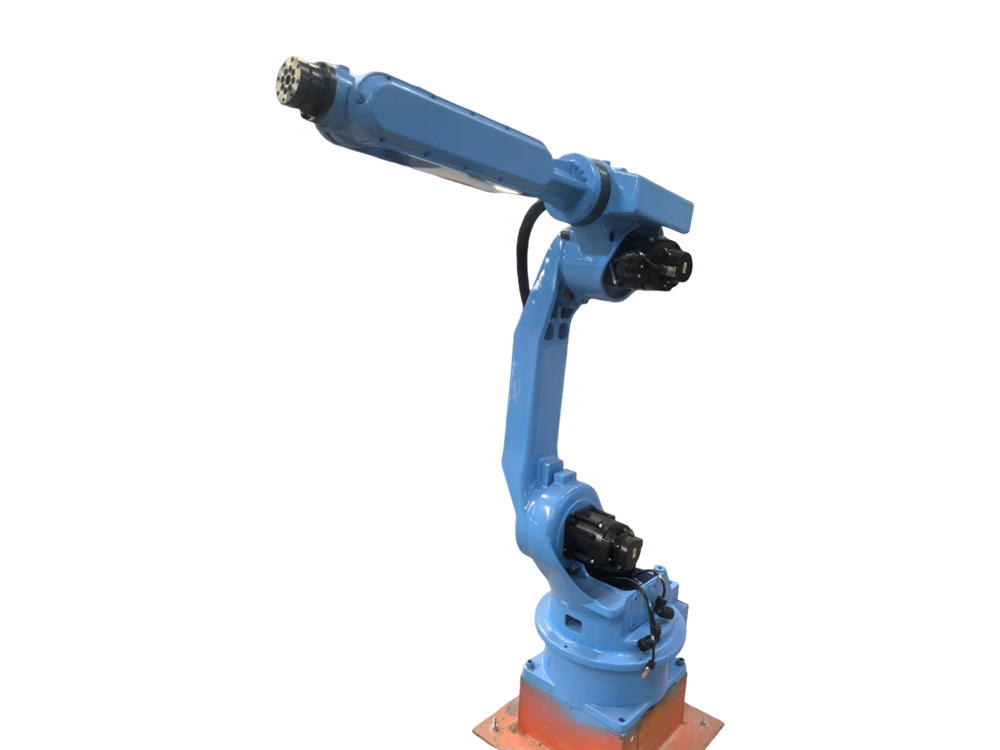
How to Choose the Right Industrial Robotic Arm
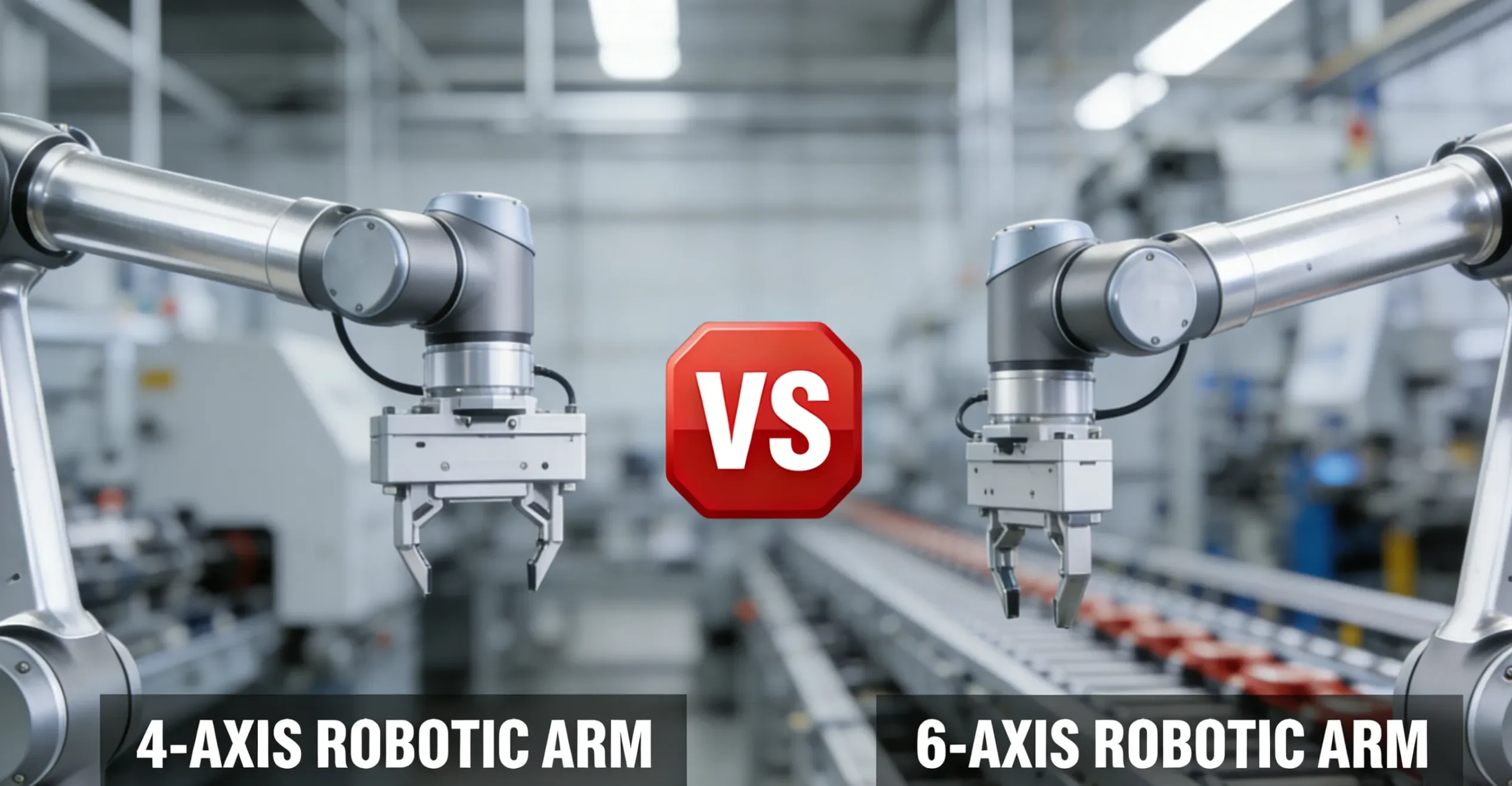
For manufacturing plants aiming to automate production, cut labor costs and improve efficiency, choosing the right industrial robotic arm is a vital investment. 4-axis and 6-axis robotic arms are the two most widely used models in factory automation
1.Core Basics: 4-Axis vs 6-Axis Robotic Arms
1.1 What Is a 4-Axis Robotic Arm
A 4-axis industrial robotic arm,most commonly theSCARA (Selective Compliance Assembly Robot Arm) mode. has 4 independent rotational joints, designed for fast, stable horizontal (X/Y) and vertical (Z) movement. It can only perform vertical pick-and-place and simple end rotation, with no tilting or pitching function. This structure makes it a high-efficiency tool for flat, repetitive tasks, with a compact body and lower cost.
1.2 What Is a 6-Axis Robotic Arm
A 6-axis articulated robotic arm ,mimics the full range of motion of a human arm,has 6 degrees of freedom, mimicking human arm movement to cover 3D position control and full posture adjustment (Roll/Pitch/Yaw). It can reach any angle, avoid obstacles and access narrow spaces, making it the most flexible option for complex spatial operations in modern factories.
Unlike 4-axis robots, 6-axis models can navigate around obstacles, reach into narrow spaces, and perform complex 3D trajectory tasks. They are the standard for flexible manufacturing, multi-process production lines, and high-complexity tasks that demand variable postures and precise spatial control.
2.4-Axis vs 6-Axis Robotic Arm: Key Parameter Comparison
| Item | 4-Axis (SCARA) | 6-Axis (Articulated) |
| Degrees of Freedom | 4 DOF, planar movement only, no tilt | 6 DOF, full 3D movement & posture adjust |
| Speed & Cycle | Faster, short cycle (0.6-1s), high-frequency tasks | Moderate speed, for complex precision work |
| Accuracy | ±0.01-0.05mm, ultra-high planar precision | ±0.02-0.05mm, stable spatial precision |
| Cost | Lower (60-80% of 6-axis), easy maintenance | Higher, complex system & programming |
| Flexibility | Low, fixed repetitive tasks only | High, adaptable to multi-process work |
This detailed comparison table covers all critical technical and operational parameters for industrial robotic arms
| Comparison Category | 4-Axis Industrial Robotic Arm (SCARA) | 6-Axis Industrial Robotic Arm (Articulated) |
| Degrees of Freedom | 4 DOF (3 horizontal + 1 vertical lift/rotation); No posture tilting/pitching | 6 DOF (3 position + 3 posture); Full 360° angle adjustment and spatial flexibility |
| Movement Range | Limited to horizontal plane + vertical lift; Only vertical end-effector posture | Full 3D workspace; Omnidirectional movement, obstacle avoidance, narrow space access |
| Operating Speed & Cycle Time | Much Faster; 120+ cycles per minute, ideal for high-speed pick-and-place; Short cycle time (0.6-1s per cycle) | Moderate Speed; Longer cycle time for complex posture adjustments; Optimized for precision over pure speed |
| Repeat Positioning Accuracy | ±0.01mm – ±0.05mm; Ultra-high planar precision for micro-assembly and precise placement | ±0.02mm – ±0.05mm; High spatial precision, stable for complex 3D tasks |
| Typical Payload Range | 1kg – 60kg; Mainstream 1-20kg for light assembly; Higher rigidity for vertical lifting | 3kg – 500kg+; Wide range from light precision to heavy-duty industrial tasks |
| Structure & Footprint | Compact, horizontal articulated structure; Small footprint, easy to integrate into tight production lines | Vertical multi-joint structure; Larger footprint, needs extra space for full-range motion |
| Initial Cost & Maintenance | Lower Cost; 60%-80% of 6-axis robot price; Simple structure, low maintenance cost, easy programming | Higher Cost; Complex control system and joints; Higher maintenance and programming skill requirements |
| Production Flexibility | Low; Specialized for fixed planar tasks; Long reprogramming time for production changes | High; Universal for multi-process tasks; Quick reprogramming for product line switches |
3.Ideal Application Scenarios for Factories
3.1 Best for 4-Axis Robotic Arms
4-axis robots are perfect for high-speed, flat-surface tasks with fixed postures, such as CNC machine loading and unloading, 3C electronics assembly, PCB plug-in, precision dispensing, food and pharmaceutical packaging, and light material handling. They shine in mass-production lines with simple, repeated actions.
3.2 Best for 6-Axis Robotic Arms
6-axis robots suit complex tasks requiring angle adjustment and 3D movement, including automotive welding and painting, parts grinding and polishing, irregular workpiece handling, mixed palletizing, and small-batch custom production. They are ideal for flexible manufacturing lines with frequent process changes.
3.3 Best Applications for 4-Axis Industrial Robotic Arms
4-axis SCARA robots are engineered for high-speed, cffkcr tasks where vertical-only posture is sufficient. They deliver unbeatable cost efficiency and speed for these scenarios, making them the top pick for mass-production assembly and material handling lines.
- Electronics Manufacturing (3C Industry): PCB board plug-in, chip mounting, precision dispensing, screw locking, and small component assembly
- Machine Tool Loading & Unloading: Rapid part transfer between CNC machines, lathes, and milling machines
- Food & Pharmaceutical Packaging: High-speed sorting, boxing, carton sealing, and light palletizing
- New Energy (PV & Lithium Battery): Battery cell sorting, small component assembly, and flat-surface handling
- General Light Assembly: Simple product assembly, label attaching, and repetitive transfer tasks
3.4 Best Applications for 6-Axis Industrial Robotic Arms
6-axis articulated robots are the go-to choice for complex 3D spatial tasks, variable posture operations, and flexible manufacturing. Their full-range motion makes them irreplaceable for tasks that require tilting, flipping, welding, or contour following.
- Automotive Manufacturing: Body welding, spray painting, parts grinding, polishing, and complex assembly
- Aerospace & Precision Machining: Complex part grinding, non-destructive testing, and precision assembly in narrow spaces
- Heavy-Duty Material Handling: Irregular part grabbing, mixed SKU palletizing/depalletizing, and heavy load transfer
- Custom & Small-Batch Production: Multi-variety product assembly, quick process switching, and flexible automation
- Specialized Processing: Welding, cutting, deburring, and surface treatment that require angled operation
Follow this simple rule to pick the right model without overspending or mismatching tasks:
Choose 4-Axis If: Your tasks are limited to horizontal and vertical movement, no tilting or flipping; you need fast cycle times and a tight budget; your production line has limited space and runs fixed, repetitive work.
Choose 6-Axis If: Your tasks need 3D movement, obstacle avoidance or angle adjustment; you handle complex/irregular workpieces; you need flexible production for multi-variety orders; you require welding, grinding or complex assembly.
Besides axis count, confirm payload, working radius and precision to match your actual production needs, and balance upfront cost with long-term return on investment.
4.Analyze Your Production Task Requirements First
The first step in selecting an industrial robotic arm is to map your exact production needs, not just prioritize low cost or high flexibility. Ask these core questions to narrow your options:
- Is your task limited to a horizontal plane (pick-and-place, assembly) or requires 3D spatial movement (welding, grinding)?
- Does the end effector need to tilt, pitch, or flip, or only operate vertically?
- What is your required cycle time (high-speed mass production or low-speed precision processing)?
- What is the maximum weight of the workpiece (including grippers/tools) – define your exact payload demand
- How much working radius (reach) do you need to cover your production station?
4.2 Clear Selection Rules: Choose 4-Axis or 6-Axis Robotic Arm
Choose a 4-Axis Robotic Arm If:
- Your production tasks are planar and repetitive, with no complex posture adjustments
- You prioritize high speed, short cycle time, and low upfront investment
- Your production line has limited space, and you need a compact automation solution
- Your team has limited robot programming and maintenance experience
- You run mass-production lines with fixed processes and rare product changes
Choose a 6-Axis Robotic Arm If:
- Your tasks require 3D spatial movement, obstacle avoidance, or angled operation
- You need a versatile robot for multiple processes and flexible production
- You handle complex parts, irregular workpieces, or small-batch custom orders
- You plan to scale automation and switch production processes frequently
- Your tasks include welding, grinding, painting, or deep assembly in narrow spaces
4.3 Additional Critical Selection Factors for Factory Robots
Beyond axis count, consider these practical factors to ensure long-term usability and ROI:
- Budget Range: Balance upfront cost, operating cost, and maintenance cost; 4-axis offers faster ROI for simple tasks
- Installation Space: Measure your workshop space and confirm robot footprint and motion range
- Precision Requirements: Ultra-precision planar tasks favor 4-axis; complex spatial precision needs 6-axis
- After-Sales & Maintenance: Choose a model with accessible spare parts and technical support for global factories
- Compatibility: Ensure the robot integrates smoothly with your existing production line, CNC machines, and control systems
There is no universal “better” robotic arm, only the most suitable one for your factory. 4-axis robotic arms are cost-effective, high-speed solutions for simple planar tasks, ideal for small and medium-sized manufacturing plants with mass production needs. 6-axis robotic arms are versatile and flexible, fitting medium to large factories with complex and diversified production requirements