
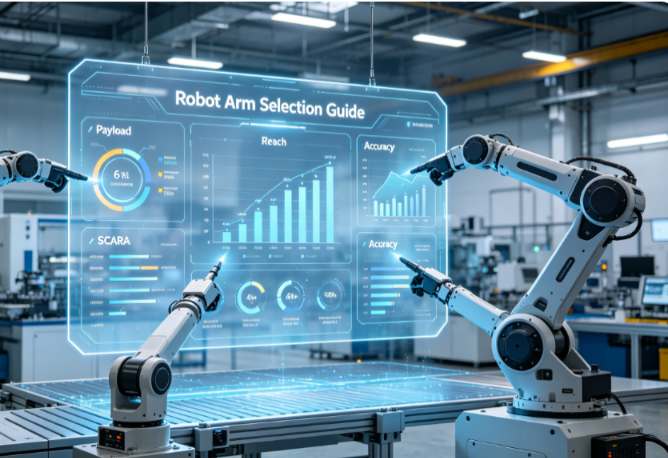
Industrial Robotic Arms: Complete Guide to Types, Uses & Selection
Industrial robotic arms are foundational equipment for modern manufacturing automation, helping factories cut labor costs, stabilize production quality, and boost operational efficiency. As industrial automation upgrades globally, manufacturers seek reliable automated equipment tailored to diverse production tasks. This complete guide analyzes the core classification, practical functions, and selection criteria of industrial robotic equipment, assisting enterprises in selecting cost-effective automation solutions for production lines.
Why Classify Industrial Robotic Arms for Selection
To begin with, professional equipment selection must be based on clear product classification. To help factory decision-makers and engineering teams make targeted upgrades, we start with robot classification and scenario matching to lay a solid foundation for scientific equipment selection.
Specifically, learning the types of industrial robotic arms and their practical application scenarios is critical for factory automation upgrades. Different automated robotic devices feature unique structures, precision and load capacity, adapting to different production scenarios. Many automation upgrade failures stem from mismatched robot types and on-site demands. Therefore, familiarizing with robot classifications helps avoid selection errors and gives full play to the automation advantages of intelligent handling equipment.
Core Application Fields of Industrial Robotic Arms
After clarifying robot types and applicable scenarios, it is necessary to further sort out mainstream industrial application fields, so as to verify whether robotic arm equipment matches actual production needs.
In general, the common industrial uses of industrial robotic arms cover manufacturing, chemical, packaging and other mainstream industries. In industrial production, automated robotic devices replace manual work in high-intensity, repetitive tasks such as PVC bag unpacking, material handling, palletizing and precision assembly. In chemical and new material factories, intelligent handling equipment undertakes sealed raw material handling work, reducing operational risks and improving overall production continuity.
Importance of Standard Robotic Arm Selection
With a clear understanding of application scenarios, standardized selection methods become the key to ensuring long-term stable operation of automation equipment. In fact, unreasonable selection is the main cause of low ROI for factory automation equipment.
For this reason, standard industrial robotic arm selection for manufacturing lines directly affects equipment ROI and long-term stability. Most buyers only focus on price while ignoring core parameters like payload, working radius and positioning accuracy. Scientific equipment selection must combine actual task types, on-site space and production demands. Proper selection can fully meet automation needs and avoid redundant investment for automated production devices.
For intuitive comparison, to help users intuitively distinguish the performance differences of different robots, we have sorted out the core parameters and advantages of mainstream industrial robotic arms in detail below. Industry authoritative data shows that targeted robot selection can improve production line efficiency by over 40%.
Overall, six mainstream robotic devices dominate industrial scenarios, with distinct performance and application advantages. The table below sorts out core parameters and applicable scenarios to support efficient equipment selection for factory automation.
Overall, six mainstream robotic devices dominate industrial scenarios, with distinct performance and application advantages. The table below sorts out core parameters and applicable scenarios to support efficient equipment selection for factory automation.
Main Types of Industrial Robotic Arms (Core Parameters & Features)
|
Robotic Arm Type
|
Core Features
|
Advantages
|
Main Industrial Uses
|
|---|---|---|---|
|
6-Axis Articulated Robotic Arm
|
6 degrees of freedom, flexible multi-angle rotation, large working envelope
|
High flexibility, strong obstacle avoidance, wide adaptability, support for complex 3D space operations
|
PVC bag unpacking, material handling, welding, palletizing, auto parts assembly
|
|
SCARA Robotic Arm
|
4-axis design, focused on horizontal high-speed movement
|
Fast speed, high repeat positioning accuracy, cost-effective
|
Electronic parts assembly, small product pick-and-place, precision sorting
|
|
Delta Parallel Robotic Arm
|
Lightweight parallel structure, ultra-fast response speed
|
Extremely high operating speed, stable operation, suitable for high-frequency cyclic tasks
|
Food sorting, pharmaceutical packaging, high-speed small material handling
|
|
Cartesian Robotic Arm
|
Linear three-axis movement, simple structural logic
|
Low cost, easy programming, strong stability, low maintenance difficulty
|
Heavy-duty material handling, linear cutting, simple loading and unloading
|
|
Cylindrical Robotic Arm
|
Base rotation + linear telescopic movement, cylindrical working range
|
Suitable for multi-station circular layout scenarios, flexible radial operation
|
Multi-station processing, raw material feeding, semi-finished product transfer
|
|
Collaborative Robotic Arm (Cobot)
|
Safe human-machine collaboration, flexible deployment, no need for safety fence
|
Lightweight, easy to move and debug, low programming threshold
|
Small batch customized production, flexible material handling, auxiliary processing
|
Core Industrial Uses of Industrial Robotic Arms
Furthermore, diverse industrial application scenarios enable flexible automation across multiple industries. Equipped with vision and adaptive control systems, modern automated robotic devices excel in PVC resin bag unpacking, powder material handling and production line palletizing. In precision manufacturing and logistics packaging, these robots also complete assembly, sorting and stacking tasks efficiently, realizing full-link unmanned production.
Accordingly, based on the above application scenarios and robot types, mastering standardized selection steps can help factories quickly lock in the most suitable automation solutions. You can also check our PVC bag unpacking robot solution for industry-specific automation cases.
Step-by-Step Industrial Robotic Arm Selection Guide for Factories
Generally speaking, reasonable industrial robotic arm selection for manufacturing lines follows four core steps. First, match robotic equipment with production tasks like unpacking, handling or assembly. Second, confirm key parameters including payload, working radius and precision. Third, select models adapting to on-site space and environmental conditions. Fourth, comprehensively evaluate equipment cost and after-sales service to guarantee stable long-term operation.
Meanwhile, to solve common doubts in actual procurement and use, we have sorted out several frequently asked questions by factory users. For more professional customization cases, browse our industrial robotic arm application cases.
FAQs
1. Which industrial robotic arm is the most practical? In most cases, the 6-axis robotic arm is the most versatile automated handling device, ideal for PVC bag unpacking and complex material handling scenarios.
2. How to maintain industrial robotic arms? In daily operation, standardized operation and regular maintenance effectively extend the service life of automated industrial robots.
3. Cobot vs industrial robotic arm: which is better? By comparison, collaborative arms suit flexible small-batch production, while traditional robotic equipment fits high-intensity, large-scale production lines.
Ultimately, combining all the above content, we can systematically summarize the value and selection logic of industrial robotic arms for modern factories.
Conclusion
To conclude, industrial robotic equipment is indispensable for manufacturing intelligent upgrading. Mastering the types of industrial robotic arms and their practical application scenarios, common industrial uses of industrial robotic arms and professional industrial robotic arm selection for manufacturing lines allows factories to configure targeted automation solutions. Especially in PVC bag unpacking and material handling processes, qualified robotic devices effectively reduce labor pressure and improve overall production benefits.