
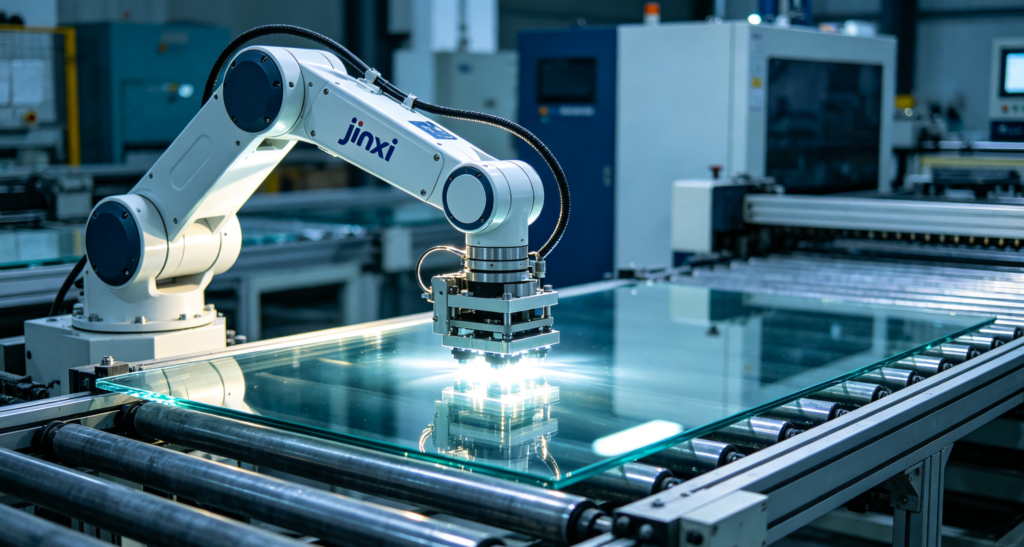
Industrial Robotic Arm for Automated Glass Production Handling
1. Introduction: Robotic Arm for Glass Production Handling
An industrial robotic arm for glass production handling is a vital automated solution for modern glass processing factories. It effectively solves common pain points of traditional manual glass handling in daily glass production lines. A professional glass handling robotic arm is customized for heavy and fragile glass panels. It delivers precise, stable, and safe material movement for flat glass, insulated glass, and architectural glass production. In addition, this robotic arm for glass production replaces repetitive manual work. It minimizes glass breakage, removes workplace safety risks, and steadily improves overall glass production efficiency for manufacturing enterprises.
2. Common Drawbacks of Traditional Manual Glass Handling
Traditional manual glass sheet transportation brings many unstable factors to modern manufacturing. First of all, manual glass handling cannot maintain consistent grabbing force. It easily causes surface scratches, edge chipping and glass breakage during glass sheet transportation. These issues lead to huge material waste every year. Secondly, long-term and repetitive glass carrying work causes severe physical strain for workers. It results in low working efficiency and frequent staff turnover. Moreover, the manual glass production process cannot support standardized processing. It creates uneven finished product quality and restricts large-scale factory development.
3. Working Advantages of Automated Glass Loading and Unloading Robotic Arm
The automated glass loading and unloading robotic arm perfectly optimizes traditional glass production workflows. The automated glass loading and unloading robotic arm is equipped with customized vacuum suction fixtures. These fixtures fit different glass sizes and ensure uniform and firm adsorption. Therefore, no sliding or damage occurs during glass grabbing and moving. Besides, the automated glass loading and unloading robotic arm supports full-automatic loading, station transfer and finished product stacking. It realizes unmanned operation of core glass production procedures. As a result, factories can effectively avoid production errors caused by manual operation and maintain stable daily output.
4. High-Precision Performance of Glass Transfer Robotic Arm
A high-precision glass transfer robotic arm greatly upgrades safety and stability in industrial glass processing. The high-precision glass transfer robotic arm provides a repeated positioning accuracy of within 0.1mm. It can accurately connect with cutting, edging and cleaning equipment in formal glass production. Meanwhile, the high-precision glass transfer robotic arm supports 24-hour non-stop operation. It never suffers from fatigue or unstable working status like human workers. Furthermore, its built-in intelligent sensor system can identify obstacles in real time. It actively adjusts moving tracks to reduce operational risks in complex glass processing environments.
5. Manual VS Robotic Arm Glass Handling: Performance Comparison
To help factory owners clearly understand the automation upgrade value, we list a detailed comparison below. It covers labor cost, product loss, working stability and safety performance. Obviously, robotic arm automation brings long-term cost-saving and efficiency-boosting benefits for glass manufacturing.
|
Evaluation Item
|
Manual Glass Handling
|
Robotic Arm Glass Handling
|
|---|---|---|
|
Labor Requirement
|
3-5 workers per production line
|
Replace 3-5 workers, one robot covers full process
|
|
Glass Breakage Rate
|
3%-5% annual breakage loss
|
Near zero breakage, effectively reduce material waste
|
|
Daily Working Hours
|
8 hours limited work, low continuity
|
24h non-stop stable operation
|
|
Product Consistency
|
Unstable, easy to produce defective products
|
Unified standard, stable product quality
|
|
Safety Risk
|
Frequent cuts, crush injuries and strain
|
Zero manual contact, eliminate workplace hazards
|
6. Conclusion
In short, adopting a robotic arm for glass production handling is a key upgrade for modern glass factories. On the one hand, professional glass handling robotic arms solve traditional manual safety and quality problems. On the other hand, they effectively cut labor costs and material loss for enterprises. Moreover, this intelligent glass processing equipment adapts to both small-batch customization and large-scale standardized production. It is a reliable long-term automation solution to improve market competitiveness for all glass manufacturing plants.