
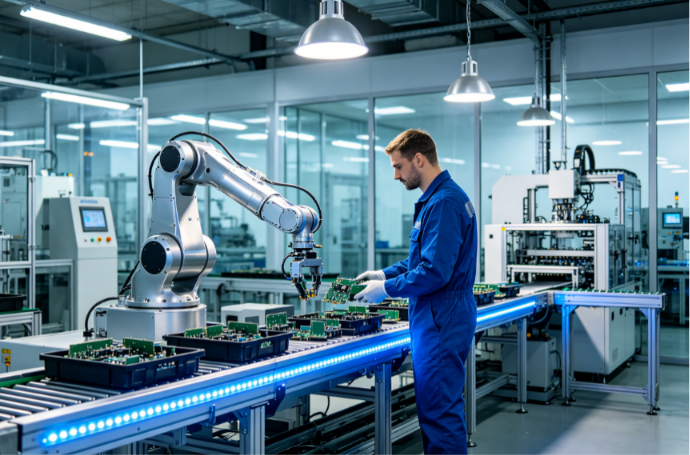
Collaborative Robots : The Flexible Automation Backbone for Global Manufacturers in 2026

Introduction
A reliable collaborative robot arm has become the core flexible automation solution for global manufacturers in 2026. Factories across Southeast Asia, Europe and North America all face labor shortages, rising labor costs and frequent small-batch production changes, and a standard collaborative robot arm solves all these pain points that traditional industrial robots cannot handle. Built to meet ISO/TS 15066 safety rules, every collaborative robot arm from our brand carries built-in collision detection sensors, allowing humans and robots to work side by side without costly safety cages. Combined with AI vision and no-code teaching, this versatile collaborative robot arm cuts factory upgrade costs and shortens ROI cycles for SMEs and large production plants alike. Global demand for a high-performance collaborative robot arm keeps rising at 25% YoY, as manufacturers replace rigid fixed automation with flexible cobot equipment.
Global manufacturing faces three universal pain points in 2026: severe labor shortages, surging manual labor expenses, and shifting consumer demand for small-batch, multi-variant production. Traditional industrial robots, with mandatory safety fencing, complex coding, and fixed workstation layouts, fail to fit agile factory needs—especially for small and medium manufacturers (SMEs).
Collaborative robots, widely known as cobots, have emerged as the game-changing automation solution. Built on ISO/TS 15066 international safety standards, cobot arms integrate built-in force-torque sensors, collision detection and soft rounded structures, allowing safe side-by-side operation with human workers without bulky protective barriers.
Driven by AI vision, lightweight modular hardware and simplified no-code programming, the global cobot market hits $3.5 billion in 2026, with a 25% year-on-year growth rate, and a projected 23.8% CAGR through 2030. Unlike early-generation light-duty cobots limited to tiny assembly tasks, today’s collaborative robotic arms cover payloads from 3kg up to 30kg, serving precision electronics assembly all the way to heavy palletizing and metal grinding.
What Makes a Collaborative Robot Arm Different From Traditional Industrial Robots
Most factory owners confuse cobots with standard robotic arms, yet the core gaps decide deployment cost, space usage and ROI:
| Comparison Factor | Traditional Industrial Robots | Collaborative Robots (Cobots) |
|---|---|---|
| Safety Requirement | Full safety cage mandatory | No cage required (post risk assessment) |
| Programming | Professional robotics engineer, offline coding, 1–3 days setup | Hand-guiding teaching, touchscreen no-code UI, 10–30 minutes setup |
| Layout Flexibility | Fixed installation, hard to relocate | Lightweight frame, movable to multiple stations |
| Upfront Infrastructure | High: fencing, dedicated power, reinforced floor | Minimal: mount on workbench, cart or ceiling |
| Production Fit | Mass single-product assembly | High-mix, low-to-medium batch flexible manufacturing |
| Typical ROI Cycle | 2–4 years | 12–24 months for most SME applications |
5 Core Competitive Advantages of 2026 AI-Enhanced Cobots
1. Built-In Human Safety Eliminates Extra Construction Costs
Every joint of a modern collaborative robot arm is equipped with multi-dimensional force sensors. When contact with operators, workpieces or obstacles is detected, the arm instantly stops movement within milliseconds. This complies with global CE, UL and ISO safety certifications, removing tens of thousands in investment for metal safety enclosures, a major financial barrier blocking SME automation adoptionAutodesk.
Workers can alternate tasks with cobots seamlessly: humans handle complex manual fitting, inspection and adjustment, while cobots take over repetitive, high-strain “3D jobs”: dull, dirty, dangerous work including loading/unloading, polishing, chemical dispensing and heavy stacking.
2. Zero-Code Hand-Guide Programming Lowers Technical Barriers
The biggest historical roadblock to robotic adoption was reliance on specialized programmers. Cobots solve this completely: operators simply grip the robot wrist, manually drag the arm through target motion paths, and the system automatically records full workflows.
Equipped with edge AI vision systems, 2026 cobots further simplify operation. Factory staff input natural language commands (“sort irregular plastic parts to left bin”) and the robot autonomously identifies unordered workpieces, optimizes grab paths and corrects position deviations without manual coordinate calibrationthetechtre…. No robotics expertise is required for daily adjustment or product changeover.
3. Ultra-Flexible, Mobile Deployment Fits Limited Factory Space
Most small workshops, food processing plants and electronics factories suffer cramped floor space. Collaborative robotic arms feature compact, lightweight mechanical structures that can be mounted on workbenches, mobile carts, machine tool frames or overhead gantries.
When production shifts between assembly, packaging and testing stations, operators reposition the entire cobot unit within minutes. For seasonal production spikes—such as holiday goods packaging or battery component batch orders—cobots deliver temporary automation without permanent production line reconstruction.
4. AI Vision Integration Solves Unordered Workpiece Handling
A defining 2026 cobot trend is native integration of low-cost 3D light-structure vision cameras. Traditional robots rely on fixed jigs to align parts, while vision-enabled cobots recognize reflective metal, transparent plastic, soft fabric and randomly stacked boxes.
Key vision-powered applications:
- Random bin picking for electronic PCBs, fasteners and plastic housings
- Defect inspection for lithium electrode sheets and solar wafers
- Unpacking bulk raw material sacks in food and chemical factories
- Position correction for metal parts before welding or grinding
5. Scalable Payload Range Covers All Manufacturing Scenarios
Cobots are no longer limited to 3kg light assembly. The market has fully matured into three mainstream payload categories to match diverse industrial demands:
- 3–10kg Light cobots: 3C electronics assembly, screw driving, glue dispensing, lab testing
- 12–20kg Medium cobots: CNC machine tending, food packaging, automotive component fitting
- 25–30kg Heavy-duty cobots: Carton palletizing, large metal part handling, battery module stackingXiangjing …
Top High-Growth Industry Applications for Collaborative Robot Arms
1. New Energy: Lithium Battery & PV Manufacturing
EV battery and solar production is the fastest-growing cobot vertical in 2026. Cobots execute dust-free, precise electrode handling, cell sorting and module assembly inside cleanrooms. Built-in anti-static coatings and low-vibration motion control reduce defective battery cells, while human-machine shared stations accelerate frequent model switching for new EV variantsltm.com.
2. 3C & Consumer Electronics Assembly
Smartphone, laptop and home appliance factories deploy cobots for screw tightening, connector insertion, adhesive dispensing and visual quality inspection. High repeatability (±0.02mm) eliminates human assembly errors, and rapid program switching supports weekly new product launches common in electronics OEMs.
3. Metal Machining, Polishing & Welding
Metal workshops widely adopt cobots for CNC loading/unloading, stainless steel polishing, deburring and collaborative MIG welding. Constant force control delivers uniform surface finish without operator fatigue, while cobots isolate workers from noise, metal dust and high-temperature hazards.
4. Food & Beverage Packaging & Palletizing
Food-grade collaborative robots with waterproof, easy-clean surface finishes handle bottle capping, carton sealing, product boxing and finished goods palletizing. They comply with global food contact safety standards and replace repetitive lifting tasks that cause chronic worker injuries.
5. General Logistics & Warehouse Depalletizing
Mid-sized warehouses replace costly fixed automation lines with mobile cobot palletizers. The arms handle mixed-size cartons, bags and plastic containers, adapting to fluctuating daily shipment volumes without permanent warehouse renovation.
Global Market Demand Trend: Why Cobots Are Exploding in Southeast Asia, Europe & North America
Southeast Asia (Vietnam, Thailand, Indonesia)
Rising local labor costs and mass manufacturing transfer from China drive explosive cobot demand. Local factories prioritize affordable, easy-deploy cobot models with minimal technical after-sales reliance, ideal for furniture, plastic injection and food processing automation.
Europe (Germany, Italy, Poland)
Strict EU labor safety regulations and severe manufacturing workforce shortages push widespread cobot adoption. European buyers demand CE-certified high-precision, cleanroom-compatible cobots for automotive component and medical device production.
North America (USA, Canada)
Shortage of skilled factory labor is the core driver. SMEs in metalworking and consumer goods prioritize fast-ROI cobot systems to cut overtime expenses and reduce employee turnover from repetitive heavy labor.
Key 2026 Cobot Technology Breakthroughs Worth Noting
- VLA Vision-Language-Action Cobot AI: Natural language operation eliminates all manual teaching for mixed-variety production
- High-payload collaborative safety algorithm: 30kg cobots maintain instant collision stop performance without sacrificing cycle speed
- Unified cross-brand control protocol: Cobots connect seamlessly with CNC machines, PLC systems and AMRs for full digital factory integration
- Dual-arm collaborative cobot units: Simultaneous two-arm operation for complex tasks like product assembly and box sealing
- Remote cloud predictive maintenance: Real-time data monitoring reduces cobot downtime by over 30%
How Manufacturers Select the Right Collaborative Robot Arm
When sourcing cobot automation solutions, factory managers should evaluate four core factors:
- Payload & Reach: Match weight and arm length to maximum workpiece size
- Working Environment: Cleanroom, food-grade, dust-proof or high-temperature protective requirements
- End Effector Ecosystem: Compatibility with grippers, vision cameras, welding torches and dispensing tools
- Certification & After-sales: CE, ISO safety certification, local technical support and spare parts supply for overseas factories
Conclusion
Collaborative robots represent the future of Industry 5.0 human-machine synergy. Unlike rigid traditional automation locked into single production modes, cobots deliver accessible, low-risk automation for manufacturers of all sizes—from small family workshops to large new energy production bases.
With continuous AI vision upgrades, expanding heavy payload capacity and falling overall system costs, collaborative robotic arms will remain the hottest automation investment globally through 2030. For factory owners struggling with labor instability and inflexible production lines, cobots offer a proven path to stable output, consistent product quality and measurable long-term operational cost reduction.