
AI Vision System for Robot Arms Revolutionizes Manufacturing
The manufacturing industry is entering a new era with the rapid adoption of AI Vision System for Robot Arms. By combining artificial intelligence, machine vision, and industrial robotics, manufacturers can achieve higher productivity, better product quality, and greater operational flexibility. Unlike traditional robotic systems that rely on fixed programming, AI-powered vision enables robot arms to identify objects, recognize patterns, and make intelligent decisions in real time. As Industry 4.0 continues to evolve, AI vision systems have become an essential technology for factories seeking to reduce downtime, improve precision, and optimize production efficiency. Advanced algorithms powered by deep learning and computer vision allow industrial robot arms to adapt to changing environments, making automation smarter than ever before.
Machine Vision for Industrial Robots Improves Precision and Quality
Machine Vision for Industrial Robots has become one of the most searched solutions in industrial automation because it dramatically enhances manufacturing accuracy. High-resolution cameras, 2D and 3D sensors, and AI-based image processing work together to inspect products, detect defects, and guide robotic movements with exceptional precision. Instead of depending solely on mechanical positioning, the robot continuously analyzes visual information to locate workpieces, measure dimensions, and verify assembly quality.
Modern factories use machine vision to perform automated inspection, component identification, barcode reading, and quality control across automotive, electronics, food processing, and pharmaceutical industries. AI algorithms also compensate for lighting changes, object orientation, and manufacturing tolerances, reducing false detections and increasing consistency. As production lines become increasingly flexible, machine vision enables industrial robots to switch between different products without extensive reprogramming, lowering operational costs while maintaining superior product quality.
3D Vision Guided Robot Arm Enables Intelligent Bin Picking
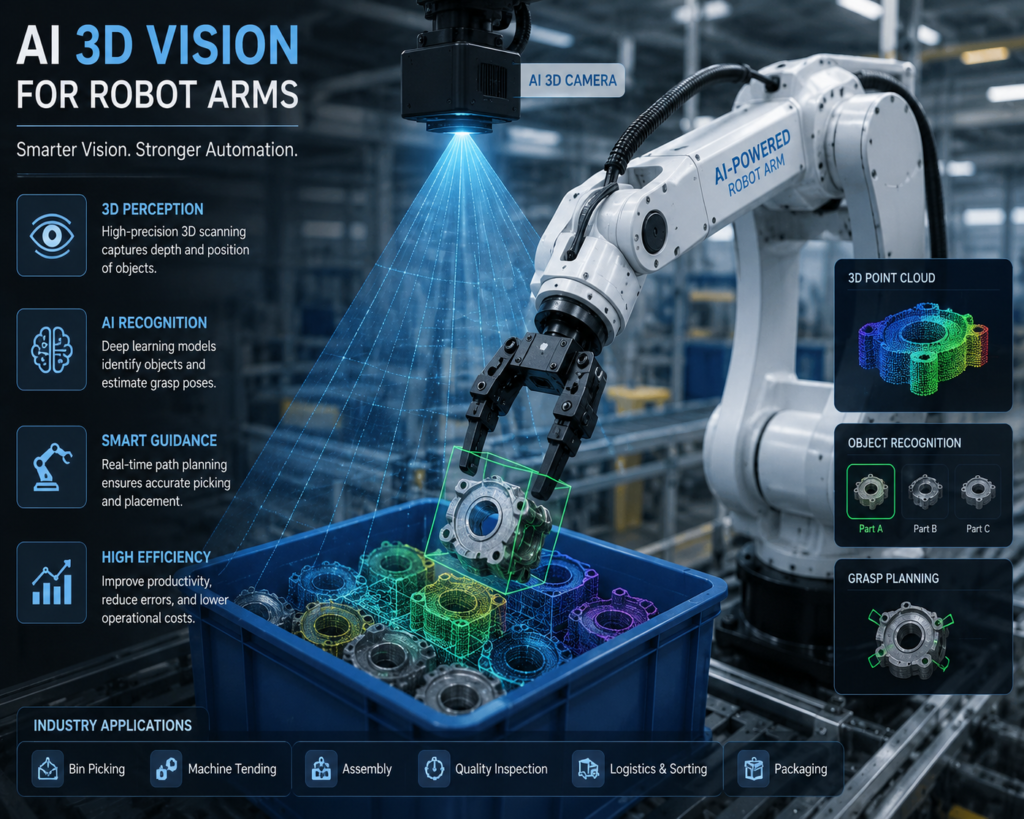
One of the fastest-growing applications is the 3D Vision Guided Robot Arm, especially for automated bin picking and flexible material handling. Traditional robotic systems often struggle when objects are randomly stacked or positioned unpredictably. AI-powered 3D vision solves this challenge by creating accurate depth maps that help robot arms calculate the exact location, orientation, and grasping angle of each object.
Using stereo cameras, structured light sensors, or time-of-flight technology, the system generates a three-dimensional representation of the workspace. Deep learning models then classify objects, estimate grasp poses, and guide robotic movements with high accuracy. This technology significantly improves warehouse automation, logistics, CNC machine tending, and assembly operations. Manufacturers benefit from shorter cycle times, fewer picking errors, and increased throughput without relying on expensive custom fixtures. As labor shortages continue to affect global manufacturing, 3D vision-guided robotic systems provide an effective solution for maintaining productivity while reducing manual intervention.
AI Robot Vision System for Automated Inspection Drives Smart Factories
An advanced AI Robot Vision System for Automated Inspection plays a critical role in building smart factories. Instead of performing only repetitive motions, industrial robot arms equipped with AI vision continuously learn from production data and improve their decision-making capabilities. Machine learning algorithms identify defects, monitor assembly processes, and verify product quality with greater speed and consistency than manual inspection.
Beyond quality assurance, AI vision systems support predictive maintenance by monitoring equipment conditions and detecting abnormal patterns before failures occur. Real-time data collected from cameras, sensors, and industrial IoT platforms can be integrated into manufacturing execution systems (MES) and enterprise resource planning (ERP) software, providing complete production visibility. As edge computing and cloud-based AI continue to mature, future robot arms will become even more autonomous, adaptive, and collaborative. Companies investing in AI vision technology today are positioning themselves for greater competitiveness, lower operating costs, higher production flexibility, and long-term digital transformation. The combination of artificial intelligence, machine vision, and industrial robotic arms is no longer a future concept—it is the foundation of modern intelligent manufacturing.