
MIG Welding Robot
Introduction
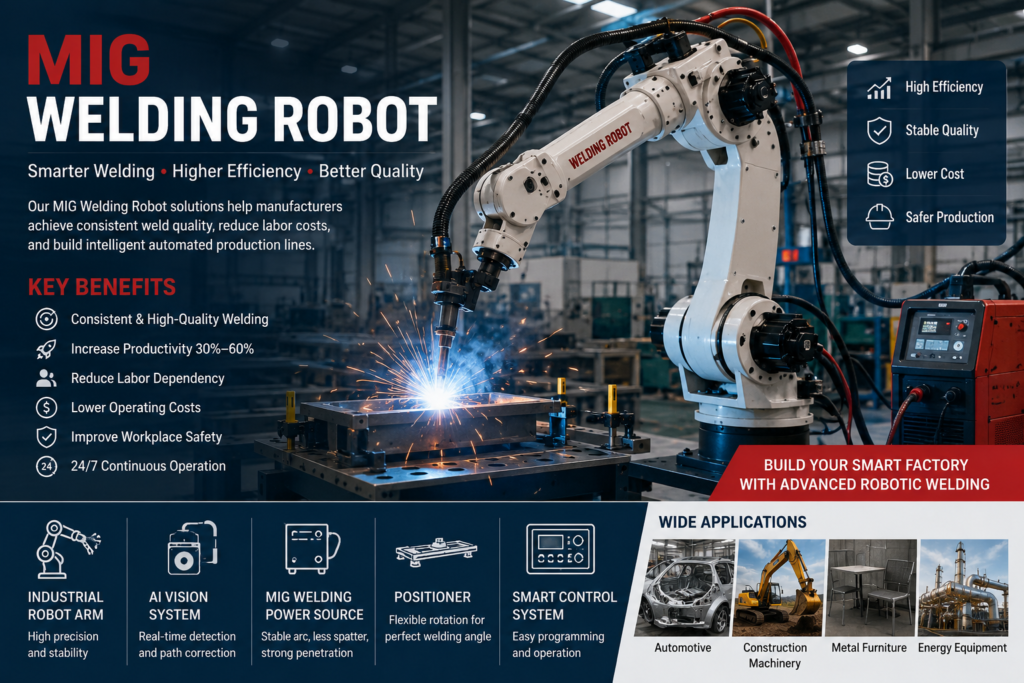
In today’s competitive manufacturing industry, a MIG Welding Robot has become one of the most valuable investments for companies looking to improve productivity, reduce labor costs, and ensure consistent welding quality. As factory automation and smart manufacturing continue to grow worldwide, more manufacturers are replacing manual welding with industrial robot arms that deliver precision, speed, and reliability. Whether producing automotive components, steel structures, agricultural machinery, or metal furniture, robotic welding solutions are transforming production lines.
Why More Manufacturers Are Choosing MIG Welding Robots
The global demand for robotic welding continues to increase as manufacturers face skilled labor shortages, rising wages, and higher quality requirements. Unlike manual welding, a robotic system can operate continuously with minimal downtime while maintaining excellent weld consistency.
A modern MIG Welding Robot integrates advanced motion control, intelligent programming, and high-precision servo systems to automate repetitive welding tasks. Combined with factory automation, companies can significantly improve production capacity without increasing labor costs.
Key advantages include:
- Consistent weld quality
- Faster production cycles
- Reduced material waste
- Lower labor dependency
- Improved workplace safety
- 24/7 continuous operation
- These benefits make robotic welding an essential part of today’s smart factory strategy.
How Robotic Welding Improves Production Efficiency
A complete robot welding system is designed to maximize throughput while minimizing production interruptions. Compared with traditional manual welding, robotic automation offers measurable improvements in both efficiency and product quality.
Performance Comparison
| Item | Manual Welding | MIG Welding Robot |
|---|---|---|
| Welding Speed | Medium | High |
| Weld Consistency | Depends on operator | Excellent |
| Labor Requirement | High | Low |
| Production Stability | Variable | Stable |
| Material Waste | Higher | Lower |
| Safety | Moderate | High |
| Operating Hours | Limited | 24/7 |
By implementing welding automation, manufacturers can reduce rework, shorten production cycles, and improve overall equipment utilization. Many factories report productivity improvements of 30–60% after adopting robotic welding technology.
Applications Across Multiple Industries
A MIG Welding Robot is suitable for a wide range of manufacturing industries.
| Industry | Typical Applications |
|---|---|
| Automotive | Frames, chassis, exhaust systems |
| Construction Machinery | Structural components |
| Agricultural Equipment | Tractor frames, attachments |
| Metal Furniture | Chairs, cabinets, shelves |
| Heavy Equipment | Steel fabrication |
| Energy Equipment | Pipelines and support structures |
| Logistics Equipment | Storage racks and conveyors |
Regardless of industry, robotic welding delivers consistent quality while reducing production costs.
Supporting Smart Factory and Industry 4.0
Today’s industrial robot arms are no longer isolated machines. They are integrated into complete factory automation systems that communicate with production software, MES systems, conveyors, and inspection equipment.
A smart robotic welding cell may include:
- Industrial Robot Arm
- MIG Welding Power Source
- Positioner
- Safety Fence
- AI Vision System
- Automatic Wire Feeder
- PLC Control
- Quality Monitoring
This integrated solution enables manufacturers to build highly efficient, data-driven production lines while supporting Industry 4.0 initiatives.
Why Choose an Industrial Robot Arm for MIG Welding?
When selecting a welding solution, manufacturers should consider several important factors.
| Selection Factor | Importance |
|---|---|
| Payload Capacity | Match workpiece weight |
| Working Radius | Cover welding area |
| Position Accuracy | Ensure weld precision |
| Programming Simplicity | Reduce setup time |
| AI Vision Compatibility | Increase flexibility |
| After-sales Support | Long-term reliability |
| Energy Efficiency | Lower operating costs |
Choosing the right industrial robot arm ensures long-term productivity and a faster return on investment.
Conclusion
As global manufacturing continues to embrace automation, the MIG Welding Robot has become one of the most effective solutions for improving productivity, reducing labor costs, and achieving superior weld quality. By combining robotic welding, welding automation, AI Vision Robot technology, and factory automation, manufacturers can build smarter, safer, and more efficient production lines.
Whether you are upgrading an existing welding process or planning a new smart factory project, investing in an industrial robot arm provides long-term value through higher efficiency, consistent product quality, and sustainable manufacturing growth