
Collaborative Robot vs Industrial Robot
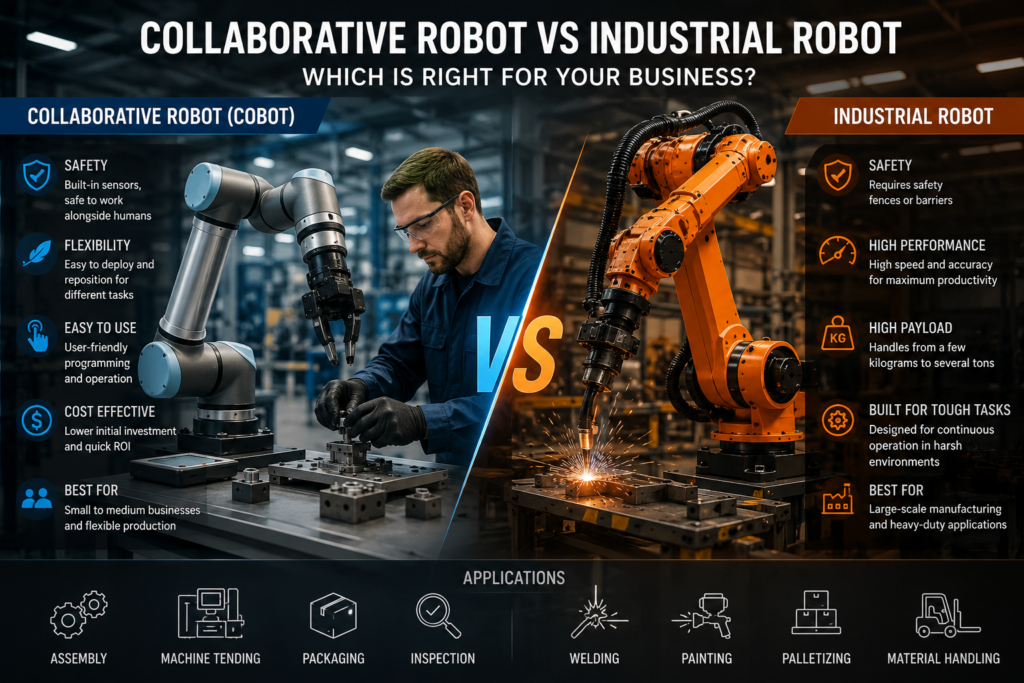
Choosing between a collaborative robot vs industrial robot is a critical decision that can shape the future of your automation strategy. Both collaborative robots and industrial robots are designed to improve productivity, accuracy, and efficiency, but they serve different purposes and work in different ways. A collaborative robot, often called a cobot, is built to work safely alongside humans, making it ideal for flexible tasks and small-batch production. An industrial robot, on the other hand, is designed for high-speed, heavy-duty applications in demanding environments. Understanding the key differences in safety, payload, speed, programming, and cost will help you decide whether a collaborative robot or an industrial robot is the right investment for your business.
Understanding the Basics
A collaborative robot (cobot) is engineered with advanced sensors, force control, and safety features that allow it to work in close proximity to people without the need for safety cages. They are lightweight, easy to program, and quick to deploy. Cobots are commonly used in applications such as assembly, machine tending, packaging, and quality inspection.
An industrial robot, however, is built for maximum performance. It can handle larger payloads, achieve higher speeds, and operate continuously in harsh conditions. Industrial robots are widely used in welding, heavy material handling, painting, and high-volume production lines.
Key Differences Between Collaborative Robots and Industrial Robots
The table below highlights the main differences between collaborative robots and industrial robots across critical factors.
| Feature | Collaborative Robot (Cobot) | Industrial Robot |
|---|---|---|
| Safety | Built-in sensors, force control, safe to work alongside humans | Requires safety fences or barriers |
| Payload Capacity | Typically up to 20–35 kg | From a few kilograms to several tons |
| Speed | Moderate speed for safe human interaction | High speed for maximum productivity |
| Programming | Easy to program, user-friendly interface | Complex programming, requires skilled operators |
| Flexibility | High flexibility, quick redeployment | Best for repetitive, dedicated tasks |
| Footprint | Compact and lightweight | Larger size and heavier structure |
| Cost | Lower initial investment | Higher initial investment |
| Applications | Assembly, machine tending, packaging, inspection | Welding, painting, palletizing, heavy material handling |
| Best For | Small to medium businesses, flexible production | Large-scale manufacturing, high-volume production |
When to Choose a Collaborative Robot
If your business needs flexibility, easy setup, and safe human-robot interaction, a collaborative robot is the ideal choice. Cobots are perfect for industries facing labor shortages or requiring frequent product changes. They can be quickly moved to new tasks, making them a smart solution for SMEs and companies with dynamic production needs.
Investing in a collaborative robot can reduce repetitive strain injuries, improve employee satisfaction, and speed up return on investment.
When to Choose an Industrial Robot
If your priority is maximum speed, heavy payload handling, and continuous operation in demanding environments, an industrial robot is the better option. These robots are designed for long-term, high-volume production with minimal downtime.
Industries such as automotive manufacturing, metal fabrication, and heavy machinery rely on industrial robots to maintain consistent quality and high throughput.