
The Ultimate Guide for Metal Stamping Automation
Introduction
In the competitive landscape of modern manufacturing, robotic press tending has emerged as a transformative technology for metal stamping facilities. As manufacturers face pressures to increase output, improve quality, and reduce operational costs, integrating industrial robotic arms for press tending has become a strategic necessity rather than an option. This comprehensive guide explores how automated press tending systems work, their profound impact on productivity, and how to select the ideal solution for your business. Whether you operate in the automotive, electronics, or aerospace sector, understanding the benefits of robotics in metal stamping is crucial for maintaining a competitive edge.
How Robotic Press Tending Works
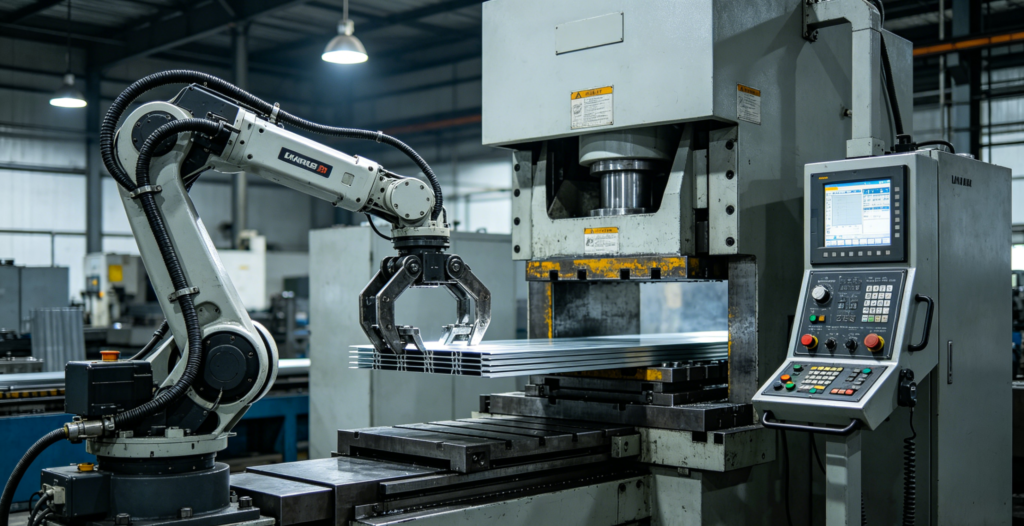
A typical robotic press tending system operates with precision and efficiency, creating a seamless workflow between raw materials and finished products. The process begins when a 6-axis robotic arm retrieves metal blanks from a feed rack or conveyor. Using advanced sensors or vision systems, the robot accurately positions the material into the press die. Once the stamping cycle concludes, the robot efficiently unloads the finished parts, transferring them to a conveyor or the next processing station. This continuous cycle ensures minimal downtime and maximizes operational efficiency.
Core Components of Robotic Press Tending
| Component | Function | Key Feature |
|---|---|---|
| Robotic Arm | Handles material loading/unloading | 6-axis flexibility for complex movements; SCARA for high-speed linear tasks |
| End-of-Arm Tooling (EOAT) | Grips and secures materials | Vacuum, magnetic, or mechanical grippers for varied part sizes/weights |
| Safety Systems | Protects personnel & equipment | Safety fences, light curtains, emergency stops (CE compliant) |
| Integration Interface | Synchronizes with press machinery | PLC communication via I/O signals or fieldbus protocols (EtherCAT) |
Key Benefits of Robotic Press Tending
Implementing robotic press tending delivers tangible, bottom-line advantages for metal stamping operations.
1. Dramatically Boost Productivity
Robotic press tending enables uninterrupted, 24/7 production, significantly increasing press utilization rates. Compared to manual operators, robots can handle faster cycle times, often boosting overall throughput by up to 30%. This is especially critical for high-volume production runs where every minute of efficiency counts.
2. Guarantee Consistent Quality
With unmatched repeatability up to ±0.01 mm, automated press tending eliminates human error, minimizing part damage and scrap rates. This ensures uniform quality across every batch, enhancing customer satisfaction and reducing material waste—a critical factor in precision industries like aerospace and medical device manufacturing.
3. Enhance Workplace Safety
By removing human workers from the hazardous vicinity of high-speed presses, robotics in metal stamping drastically reduce the risk of injuries from moving parts, sharp edges, or potential accidents. This not only improves employee well-being but also helps companies comply with stringent safety standards and lower insurance costs.
4. Reduce Long-Term Operational Costs
While the initial investment requires planning, robotic press tending provides substantial long-term savings. It eliminates recurring labor costs, reduces training and turnover expenses, and minimizes unplanned downtime through predictive maintenance features. For many businesses, the ROI is achieved within just a few years.
Real-World Applications
Robotic press tending is versatile and adaptable, serving diverse industries that rely on metal stamping.
| Industry | Application | Advantage |
|---|---|---|
| Automotive | Body panels, chassis parts, engine components | High-volume production, fast changeovers, mixed-model flexibility |
| Electronics | Small precision parts, device housings | Vision-guided accuracy, gentle handling of delicate materials |
| Aerospace & Medical | Structural parts, instrument enclosures | Ultra-precise stamping, clean room compatibility, zero defects |
How to Choose the Right Robotic Press Tending System
Selecting the ideal robotic press tending solution requires careful evaluation of your specific needs.
-
Assess Your Production Requirements
- Evaluate your production volume, part size/weight, and press type (mechanical, hydraulic, pneumatic).
- High-mix, low-volume operations may benefit from collaborative robots (cobots) for easy integration and flexibility.
- High-volume lines demand high-speed, heavy-duty industrial robots for maximum throughput.
-
Ensure Integration Compatibility
- Verify the system’s compatibility with your existing press controls, PLC, and factory floor infrastructure.
- Look for solutions that offer intuitive programming, pre-built templates for common press models, and dedicated technical support to streamline installation.
-
- Confirm the system meets international safety standards (e.g., CE).
- Prioritize providers that offer comprehensive training for your team and reliable after-sales service, including spare parts availability and maintenance plans.
Evaluate Safety and Support
Conclusion
Robotic press tending is no longer a futuristic concept—it is a proven, essential investment for any metal stamping manufacturer aiming to thrive in a global market. By automating repetitive, labor-intensive tasks, businesses can achieve higher productivity, superior quality, safer workplaces, and significant cost reductions. Whether you are a small job shop or a large original equipment manufacturer (OEM), embracing automation in press tending will future-proof your operations and position your business for long-term success.
Ready to transform your press line? Contact our experts today to design a custom robotic press tending solution tailored to your unique production needs.