
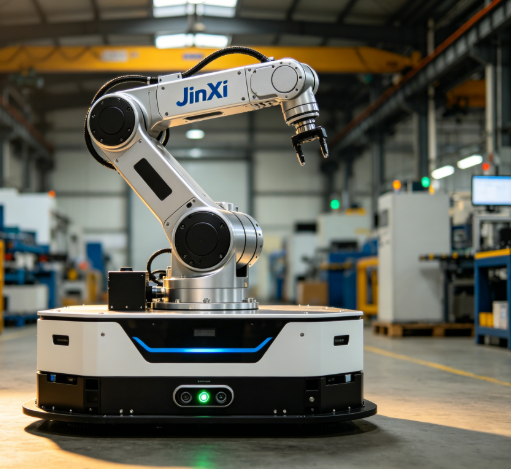
Application of Robotic Arm on AGV Guided Vehicle for Industrial Automation
Core Value of Robotic Arm on AGV Guided Vehicle
Robotic arm on AGV guided vehicle has become an indispensable integrated automation solution for modern manufacturing and warehouse logistics. Firstly, traditional Automated Guided Vehicles only focus on simple material transportation. They do not support flexible loading, unloading and sorting tasks on production sites. For this reason, standard AGV guided vehicles need functional upgrades for smarter factory operation. Equipped with a multi-joint robotic arm, these mobile vehicles turn into intelligent robotic equipment. They integrate automatic movement, precise positioning and flexible operational functions. Furthermore, this all-in-one device solves common factory operation pain points. It fixes repetitive manual handling work, low daily operational efficiency and unstable product quality on production lines. As a result, more manufacturing enterprises choose customized robotic arm on AGV guided vehicle systems. These systems help factories build unmanned workshops and cut down overall industrial production costs effectively.
1. Application Scenarios of Custom AGV Guided Vehicle With Robotic Arm
Many factory owners are looking for custom AGV guided vehicle with robotic arm for material handling to optimize their internal logistics workflows. In general, fixed robotic arms can only work at single fixed stations. In contrast, mobile robotic arms paired with AGV guided vehicles cover much wider working areas. They can finish cross-station operation across different production zones. Besides, the custom AGV guided vehicle with robotic arm for material handling can plan driving routes automatically based on real-time production demands. It drives to target workstations accurately and completes component picking, cargo stacking and material transfer tasks. In addition, its flexible structural design brings stronger environment adaptability. Therefore, the custom AGV guided vehicle with robotic arm for material handling works well in narrow production aisles and multi-layer storage shelves. It greatly improves the overall flexibility of on-site industrial logistics.
2. Precision Advantages for Warehouse Automated Management
Enterprises pursuing long-term unmanned production prefer to deployhigh precision AGV robotic arm vehicle for warehouse automation to achieve standardized warehouse management. To begin with, precision acts as the core competitive advantage of this integrated automation equipment. The device installs professional laser positioning and visual recognition modules. Thus, the high precision AGV robotic arm vehicle for warehouse automation reaches millimeter-level accuracy during driving and grabbing processes. Meanwhile, it performs stably in precision manufacturing, electronic component warehousing and finished product sorting scenarios. Correspondingly, the high precision AGV robotic arm vehicle for warehouse automation prevents cargo damage and positioning errors from manual operation. Moreover, it supports 24-hour non-stop stable operation. It effectively boosts daily working efficiency for industrial warehouses and manufacturing workshops.
3. Cost Performance for Factory Mass Deployment
Cost performance and durability are key procurement factors for most enterprises. Hence, cost-effective mobile robotic arm AGV vehicle for factory use stays a top searched industrial automation device. In fact, factories of all scales can adopt this integrated equipment. It fits small processing workshops and large intelligent manufacturing bases equally well. Additionally, the cost-effective mobile robotic arm AGV vehicle for factory use fully replaces traditional manual handling and separated automation devices. Compared with buying independent AGV vehicles and fixed robotic arms, this integrated model saves more procurement space and budget. Apart from that, the cost-effective mobile robotic arm AGV vehicle for factory use features a low failure rate and simple daily maintenance. It successfully reduces long-term operation and maintenance costs for manufacturing enterprises.
4. Standard AGV VS Robotic Arm AGV Parameter Comparison
|
Parameter
|
Standard AGV Vehicle
|
AGV Guided Vehicle with Robotic Arm
|
|---|---|---|
|
Core Function
|
Single cargo transportation
|
Transportation, picking, stacking, sorting
|
|
Operation Flexibility
|
Low, fixed route operation
|
High, adjustable intelligent route planning
|
|
Positioning Accuracy
|
Centimeter-level
|
Millimeter-level
|
|
Applicable Scenarios
|
Simple cargo transfer
|
Factory production lines, warehouse storage, precision handling
|
|
Labor Cost Saving
|
30%
|
65%+
|
5. Conclusion & Industrial Development Trend
In summary, the combination of robotic arms and AGV guided vehicles breaks the functional limits of single automation equipment. On one hand, it supports customized material handling and high-precision warehouse management. On the other hand, it helps factories complete low-cost intelligent upgrades. For these reasons, integrated AGV robotic arm vehicles create huge practical value for industrial transformation. In the future, as automation technology continues to upgrade, robotic arm on AGV guided vehicle will become mainstream logistics handling equipment. It will assist global manufacturing enterprises in achieving unmanned, efficient and low-cost intelligent production.