
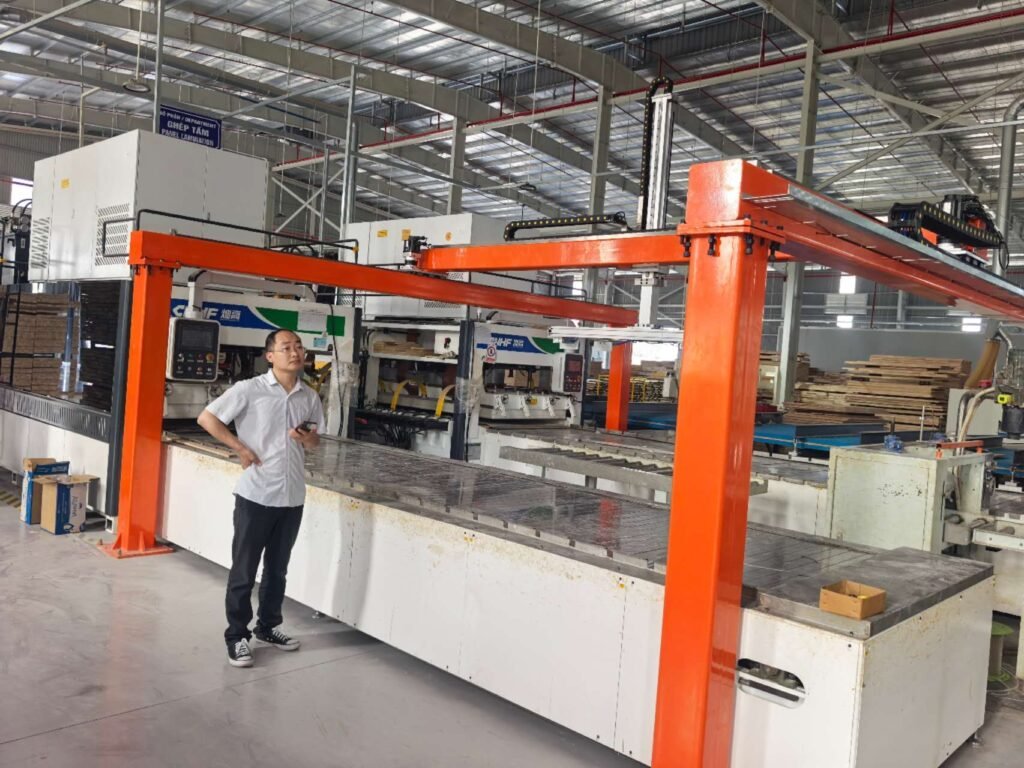
Gantry Loading and Unloading Machine: The Smart Investment for Woodworking Material Handling
In today’s competitive woodworking and furniture manufacturing industries, the gantry loading and unloading machine has emerged as a game-changing solution for optimizing material handling workflows. As factories face rising labor costs, labor shortages, and demands for consistent production quality, the gantry loading and unloading machine is no longer a luxury add-on but a core component of modern automated production lines. Unlike manual handling, which is slow, error-prone, and unsafe, these automated systems deliver reliable, repeatable performance while reducing operational risks. Whether integrated with high-frequency panel presses, CNC routers, or assembly lines, the gantry loading and unloading machine transforms how factories move heavy wooden panels, lumber, and finished products across the production floor.
Boost Production Efficiency with Automated Panel Handling
One of the most significant advantages of the automated panel handling gantry system is its ability to eliminate production bottlenecks caused by manual labor. Traditional material handling relies on workers to lift, carry, and position heavy wooden boards, a process that is slow, inconsistent, and limited by human fatigue. A high-performance automated panel handling gantry system, by contrast, operates at a constant, optimized speed 24/7, drastically increasing line throughput.
The table below highlights the key differences between manual handling and the automated panel handling gantry system in a typical woodworking panel production line:
| Aspect | Manual Panel Handling | Automated Panel Handling Gantry System |
|---|---|---|
| Throughput Consistency | Variable, affected by breaks, fatigue, and shift changes | Constant, pre-programmed speed with zero downtime |
| Cycle Time per Panel | 2–3 minutes (including rest periods) | 30–45 seconds, with repeatable accuracy |
| Labor Required | 2–3 workers per line shift | 0 direct labor for handling; 1 operator for supervision |
| Product Damage Risk | High (scratches, dents from drops or improper handling) | Near-zero (gentle vacuum suction and controlled movement) |
With the automated panel handling gantry system integrated into your workflow, factories can process up to 3x more panels per shift while maintaining uniform quality across every batch.
Reduce Workplace Risks with Safe, Ergonomic Material Transfer
The woodworking gantry loading and unloading robot directly addresses the serious safety hazards associated with manual material transfer in woodworking facilities. Lifting heavy wooden panels repeatedly exposes workers to chronic back injuries, strains, and acute accidents such as slips or falling objects. In many countries, rising workplace injury claims and strict labor regulations are making manual handling an increasingly costly liability for employers.
The woodworking gantry loading and unloading robot eliminates these risks entirely by taking over the heavy lifting. Equipped with robust vacuum suction cups, safety sensors, and collision avoidance systems, these robots move materials with precise control, eliminating the need for workers to enter high-risk zones. Beyond protecting employee health, investing in the woodworking gantry loading and unloading robot also reduces indirect costs such as insurance premiums, workers’ compensation claims, and production downtime due to accidents. For factories aiming to meet international safety standards, these automated systems are not just a choice but a necessity for sustainable operations.
Turn Automation into Long-Term Profit with Smart Labor Replacement
Many factory owners mistakenly view the gantry loader unloader for woodworking lines as an expensive expense, rather than what it truly is: a high-return investment. While the initial cost of a gantry loader unloader for woodworking lines may seem significant, the long-term savings and financial benefits quickly outweigh the upfront expenditure. Replacing manual labor with automation means eliminating recurring costs such as wages, overtime, training, and employee benefits.
On average, a gantry loader unloader for woodworking lines pays for itself in 12–18 months through direct labor savings alone. Beyond cost reduction, these systems also deliver indirect financial gains: they minimize material waste from handling errors, reduce downtime caused by labor shortages, and increase production capacity to meet growing customer demand. Unlike hiring workers, who require ongoing management and turnover, the gantry loader unloader for woodworking lines operates consistently year after year, generating predictable returns and freeing up capital to invest in other areas of the business. For woodworking factories looking to scale and compete globally, automation is the key to turning operational costs into sustainable profits.
Conclusion
The gantry loading and unloading machine is more than just a material handling tool—it is a strategic asset that drives efficiency, safety, and profitability in woodworking production. From boosting throughput with automated panel handling gantry systems to protecting workers with woodworking gantry loading and unloading robots, and delivering rapid ROI with gantry loader unloaders for woodworking lines, these systems address the core challenges of modern manufacturing. Investing in automation is not about cutting jobs; it is about elevating your factory’s capabilities, ensuring consistent quality, and building a resilient business that can thrive in a fast-changing market.